
 WhatsApp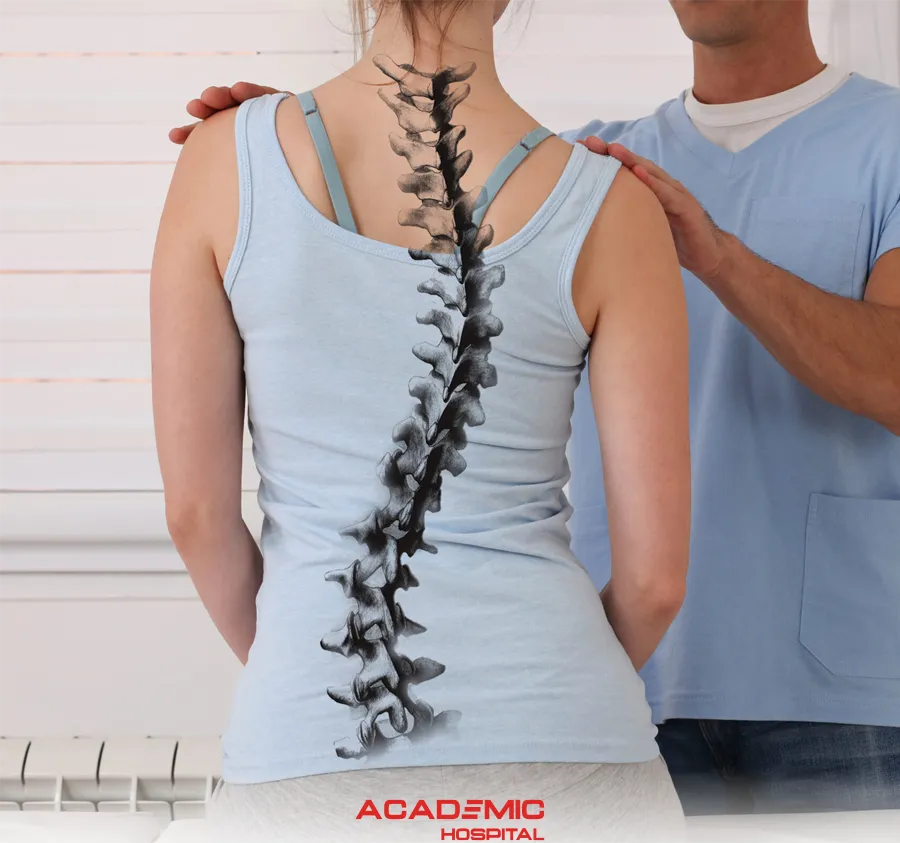
What Is Scoliosis? Symptoms, Curve Severity and Treatment
Contents
- What Is Scoliosis?
- What Causes Scoliosis?
- What Are the Types of Scoliosis?
- What Are the Symptoms?
- Scoliosis in Children and Adolescents
- How Is Scoliosis Diagnosed?
- What Is the Cobb Angle?
- How Is Scoliosis Treated?
- When Is Observation Used?
- Exercise and Physiotherapy
- When Is Bracing Used?
- When Is Surgery Needed?
- Surgical Treatment
- What Is Vertebral Body Tethering?
- Recovery After Scoliosis Surgery
- Frequently Asked Questions
What Is Scoliosis?
Scoliosis is a three-dimensional spinal deformity involving both lateral curvature of the spine and rotation of the vertebrae.
Minor spinal asymmetry is not necessarily scoliosis. A Cobb angle of 10 degrees or greater on a standing spinal radiograph is commonly used as part of the definition of scoliosis.
The curve may involve different areas of the spine and can appear C-shaped or S-shaped when viewed from the front or back.
What Causes Scoliosis?
The cause depends on the type of scoliosis.
The most common form in children and adolescents is adolescent idiopathic scoliosis. The term idiopathic means that no single specific cause has been identified.
Scoliosis can become more apparent or progress during periods of rapid growth, but rapid growth itself is not considered the sole cause of scoliosis.
Other forms can be associated with congenital spinal abnormalities, neuromuscular disorders and certain genetic or syndromic conditions.
What Are the Types of Scoliosis?
- Idiopathic scoliosis: No single underlying cause is identified.
- Congenital scoliosis: Associated with structural differences in spinal development before birth.
- Neuromuscular scoliosis: Associated with disorders such as cerebral palsy and certain neuromuscular diseases.
- Adult degenerative scoliosis: Can develop with age-related degeneration of spinal discs and joints.
What Are the Symptoms of Scoliosis?
Mild scoliosis often causes no pain, and body asymmetry may be the first noticeable sign.
Possible signs include:
- One shoulder appearing higher than the other
- One shoulder blade appearing more prominent
- Asymmetry of the waist
- Uneven hips
- The trunk appearing shifted to one side
- A rib or back prominence during forward bending
- Clothing hanging unevenly
Scoliosis in Children and Adolescents
Idiopathic scoliosis can develop during childhood and adolescence, and the risk of progression can increase during periods of rapid skeletal growth.
Management therefore considers not only age but also the Cobb angle, curve pattern, documented progression and remaining skeletal growth.
Skeletal maturity can be assessed using findings such as the Risser grade and other growth-related measures.
How Is Scoliosis Diagnosed?
Assessment begins with physical examination.
Shoulder, scapular, waist and pelvic symmetry are evaluated. During the Adam forward-bend test, trunk rotation and rib prominence can become more apparent. A scoliometer may be used to measure trunk rotation.
When scoliosis is suspected, standing full-spine radiographs are generally used to confirm the diagnosis and measure curve magnitude.
MRI is not required routinely for every patient. It can be considered when neurological abnormalities, an atypical curve pattern, unexplained significant pain or another spinal-cord disorder is suspected.
What Is the Cobb Angle?
The Cobb angle is the standard radiographic measurement used to quantify the magnitude of a scoliosis curve.
Curves below 10 degrees are generally not classified as scoliosis.
The Cobb angle is important for treatment planning but should not be used alone. Remaining growth and documented curve progression also influence management.
How Is Scoliosis Treated?
There is no single treatment suitable for every scoliosis patient.
Management depends on age, skeletal maturity, curve magnitude, progression, curve location and flexibility, and the patient's overall health.
Options include observation, scoliosis-specific exercises, bracing and surgery in selected patients.
When Is Observation Used?
Mild curves and curves considered to have a relatively low risk of progression can be monitored.
The purpose of observation is to identify whether the curve progresses while the child is growing.
Follow-up intervals and repeat radiographs are individualised according to curve magnitude, remaining growth and progression risk.
Exercise and Physiotherapy for Scoliosis
General physical activity remains important for children and adolescents with scoliosis unless a specific restriction is recommended.
Physiotherapeutic scoliosis-specific exercises (PSSE) can include three-dimensional self-correction, postural control, stabilisation and training for activities of daily living.
Exercise programmes should be individualised according to the patient's curve pattern and delivered by appropriately trained physiotherapists.
When Is Bracing Used?
Bracing is primarily used in growing children and adolescents whose curves are considered at risk of progression.
The Scoliosis Research Society generally recommends bracing for appropriate growing patients with curves of approximately 25–45/50 degrees.
The primary purpose of a brace is not to permanently straighten the spine but to reduce the risk of progression during growth and, where possible, prevent the curve from reaching a surgical range.
Brace type and wear schedule are individualised according to curve pattern, magnitude, growth and body shape.
When Is Scoliosis Surgery Needed?
Most patients with scoliosis do not require surgery.
Surgery can be considered for large curves, curves that continue to progress during growth, appropriate patients whose curves progress despite bracing, or large curves that remain at substantial risk of progression after skeletal maturity.
In adolescent idiopathic scoliosis, surgery is commonly considered when curves reach approximately 45–50 degrees or are judged to have a high risk of continued progression.
The decision is not based on the Cobb angle alone. Curve pattern, flexibility, skeletal maturity and overall trunk balance are also considered.
How Is Scoliosis Surgery Performed?
One of the most commonly used procedures for adolescent idiopathic scoliosis is posterior spinal fusion with instrumentation.
Screws are attached to the vertebrae and connected with rods to correct the three-dimensional deformity and stabilise the spine.
The aim is not necessarily to produce a perfectly straight radiograph. Surgical goals include limiting future progression, improving spinal and trunk balance and preserving as many mobile spinal segments as reasonably possible.
What Is Vertebral Body Tethering?
Vertebral Body Tethering (VBT) is a fusionless growth-modulation procedure used in selected skeletally immature children and adolescents.
Screws are placed along the side of the vertebral bodies and connected with a flexible tether. Continued spinal growth is used to influence the curve over time.
VBT is not appropriate for every scoliosis patient and should not be regarded as a direct replacement for posterior spinal fusion in all cases.
Age, skeletal maturity, curve magnitude, flexibility and curve pattern are important when selecting patients.
Recovery After Scoliosis Surgery
Recovery depends on the procedure and the individual patient.
After posterior fusion, patients are generally mobilised early and begin walking during the initial postoperative period.
Following adolescent idiopathic scoliosis surgery, hospitalisation usually lasts several days, routine daily activities and school can often resume within several weeks, and return to more demanding physical activity occurs gradually over the following months according to healing and the surgeon's assessment.
Not Every Scoliosis Curve Requires Surgery
Treatment is based on curve magnitude and progression together with age and remaining skeletal growth. Observation, scoliosis-specific exercises, bracing or surgery can be selected according to the individual patient.
Frequently Asked Questions
References
- Academic Hospital. Scoliosis
- Scoliosis Research Society. Adolescent Idiopathic Scoliosis
- Scoliosis Research Society. Bracing
- Scoliosis Research Society. Scoliosis Surgery
- SOSORT. Guidelines for Orthopaedic and Rehabilitation Treatment of Idiopathic Scoliosis During Growth