

 WhatsApp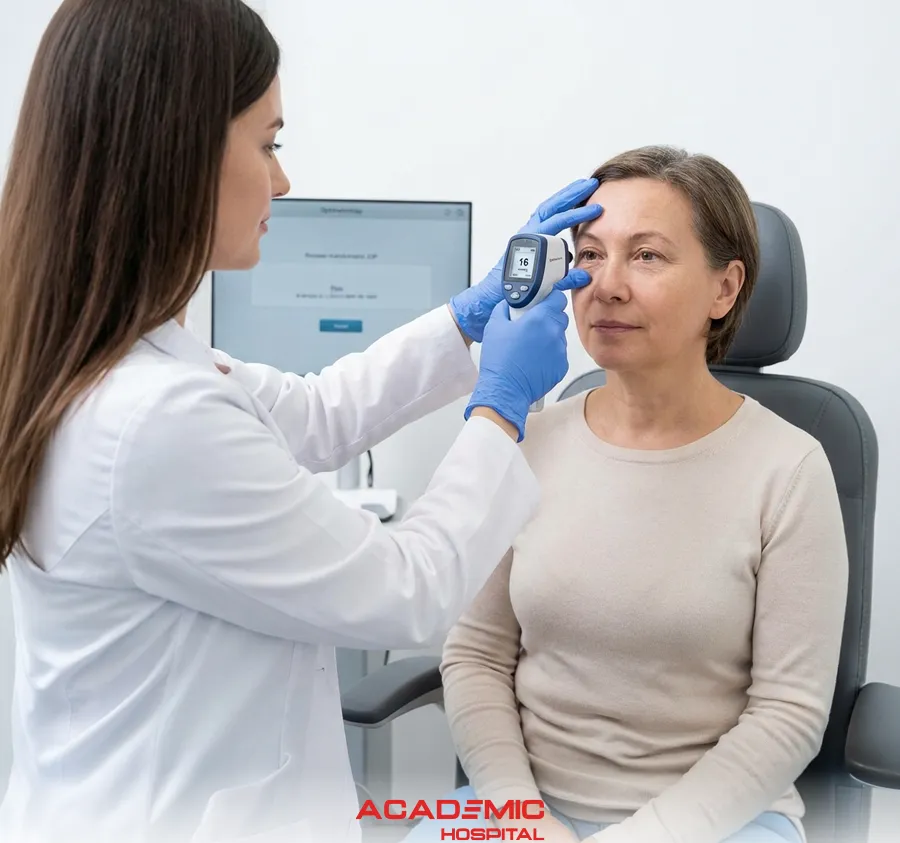
Glaucoma Diagnosis and Treatment
Contents
- What Is Glaucoma?
- Are Glaucoma and High Eye Pressure the Same?
- What Are the Symptoms?
- What Is Acute Angle-Closure Glaucoma?
- How Is Glaucoma Diagnosed?
- OCT and Visual Field Testing
- Risk Factors
- Why Is Early Diagnosis Important?
- How Is Glaucoma Treated?
- Eye Drops
- Laser Treatment
- Glaucoma Surgery
- What Happens If Glaucoma Is Untreated?
- Frequently Asked Questions
What Is Glaucoma?
Glaucoma is a group of eye diseases that can progressively damage the optic nerve at the back of the eye.
The optic nerve carries visual information from the eye to the brain. Progressive glaucomatous damage can cause permanent visual-field loss.
The most common form, open-angle glaucoma, usually develops slowly and may cause no noticeable symptoms during its early stages.
Are Glaucoma and High Eye Pressure the Same?
No. Intraocular pressure (IOP) describes the pressure inside the eye.
Elevated IOP increases the risk of optic-nerve damage, but some people have elevated IOP without glaucomatous optic-nerve damage. This may be described as ocular hypertension.
Conversely, normal-tension glaucoma can occur in people whose measured eye pressure is not considered abnormally high.
Glaucoma therefore cannot be diagnosed from an eye-pressure reading alone.
What Are the Symptoms of Glaucoma?
Open-angle glaucoma typically causes no symptoms in its early stages.
As the disease progresses, patients may develop:
- Loss of peripheral vision
- Blind spots in the visual field
- Progressive narrowing of the visual field
- Central vision impairment in advanced disease
A greenish colour change of the eye is not considered a typical modern clinical symptom of open-angle glaucoma.
What Is Acute Angle-Closure Glaucoma?
In acute angle closure, the drainage angle inside the eye can become blocked suddenly, causing eye pressure to rise rapidly.
Seek urgent ophthalmic care for sudden onset of:
- Severe eye pain
- A red eye
- Sudden blurred vision
- Halos around lights
- Headache
- Nausea or vomiting
Acute angle-closure glaucoma is a medical emergency because vision can be threatened rapidly.
How Is Glaucoma Diagnosed?
No single test is sufficient to diagnose glaucoma in every patient.
Assessment can include:
- Intraocular pressure measurement
- Optic-nerve examination
- Visual-field testing
- Optical coherence tomography (OCT)
- Central corneal thickness measurement
- Gonioscopy to assess the drainage angle
- Dilated eye examination
Testing and follow-up intervals are individualised according to glaucoma type, risk and evidence of progression.
What Do OCT and Visual Field Tests Show?
OCT provides high-resolution structural information about the retinal nerve fibre layer and structures surrounding the optic nerve.
Visual-field testing assesses the functional effect of glaucoma and can identify areas in which visual sensitivity has been reduced.
OCT therefore provides predominantly structural information, while visual-field testing provides functional information. Both can be useful for diagnosis and monitoring.
What Are the Risk Factors for Glaucoma?
- Elevated intraocular pressure
- Increasing age
- A first-degree relative with glaucoma
- High myopia
- Thin central cornea
- Prolonged or intensive corticosteroid exposure
- Certain previous eye injuries or eye diseases
Low eye pressure itself should not be presented as a standard glaucoma risk factor. Normal-tension glaucoma describes optic-nerve damage occurring despite IOP readings that are not considered abnormally high.
Why Is Early Diagnosis Important?
Optic-nerve damage and visual loss that have already occurred from glaucoma are generally irreversible.
The purpose of treatment is therefore to preserve remaining vision and reduce the risk of further damage.
Because open-angle glaucoma may be asymptomatic in its early stages, examination schedules should be based on individual age, family history, IOP, optic-nerve findings and other risk factors rather than waiting for symptoms.
How Is Glaucoma Treated?
The central aim of glaucoma treatment is to lower intraocular pressure sufficiently to reduce the risk of additional optic-nerve damage.
There is no single target pressure that is suitable for every patient. The target can depend on disease severity, rate of progression, baseline IOP, age and other clinical factors.
Treatment may include:
- Prescription eye drops
- Laser treatment
- Trabeculectomy
- Glaucoma drainage implants
- Minimally invasive glaucoma surgery (MIGS) in selected patients
How Do Glaucoma Eye Drops Work?
Glaucoma medicines lower IOP by reducing fluid production inside the eye or increasing fluid drainage.
Several medication classes can be used, including prostaglandin analogues, beta blockers, carbonic anhydrase inhibitors and other pressure-lowering medicines.
Treatment selection should consider both ocular findings and the patient's general medical condition.
When Is Laser Treatment Used for Glaucoma?
Laser treatment is not limited to patients whose eye drops have failed.
Selective laser trabeculoplasty (SLT) can lower IOP in open-angle glaucoma by improving fluid drainage through the trabecular meshwork.
Current NICE recommendations offer 360° SLT as an initial treatment option for appropriately selected people with newly diagnosed chronic open-angle glaucoma that is not advanced.
The effect can diminish with time, and repeat SLT or additional pressure-lowering medication may later be required.
Different laser procedures, including laser peripheral iridotomy, can be used in angle-closure disease.
What Types of Glaucoma Surgery Are Used?
Surgery may be considered when adequate pressure control cannot be achieved with medicines and/or laser treatment, or when the risk of progression is sufficiently high.
- Trabeculectomy: Creates an alternative pathway for aqueous fluid to leave the eye.
- Glaucoma drainage implants: Use a tube or shunt to improve drainage.
- MIGS: Includes a group of minimally invasive procedures that may be suitable for selected patients, often with less advanced disease.
No single surgical method is appropriate for every patient.
What Happens If Glaucoma Is Untreated?
Uncontrolled glaucoma can cause progressive optic-nerve damage.
Visual-field defects may gradually enlarge, and advanced glaucoma can eventually affect central vision and cause severe visual impairment or blindness.
Vision already lost to glaucoma is generally irreversible, but appropriate treatment and regular monitoring can slow or stop progression in many patients.
Regular Monitoring Is Important in Glaucoma
Glaucoma may cause no symptoms in its early stages. Intraocular pressure, optic-nerve examination, OCT and visual-field findings should be interpreted together when planning treatment.
Frequently Asked Questions
References
- Academic Hospital. Glaucoma
- National Eye Institute. Glaucoma
- National Eye Institute. Glaucoma and Eye Pressure
- National Eye Institute. Types of Glaucoma
- NICE. Glaucoma: Diagnosis and Management