
 WhatsApp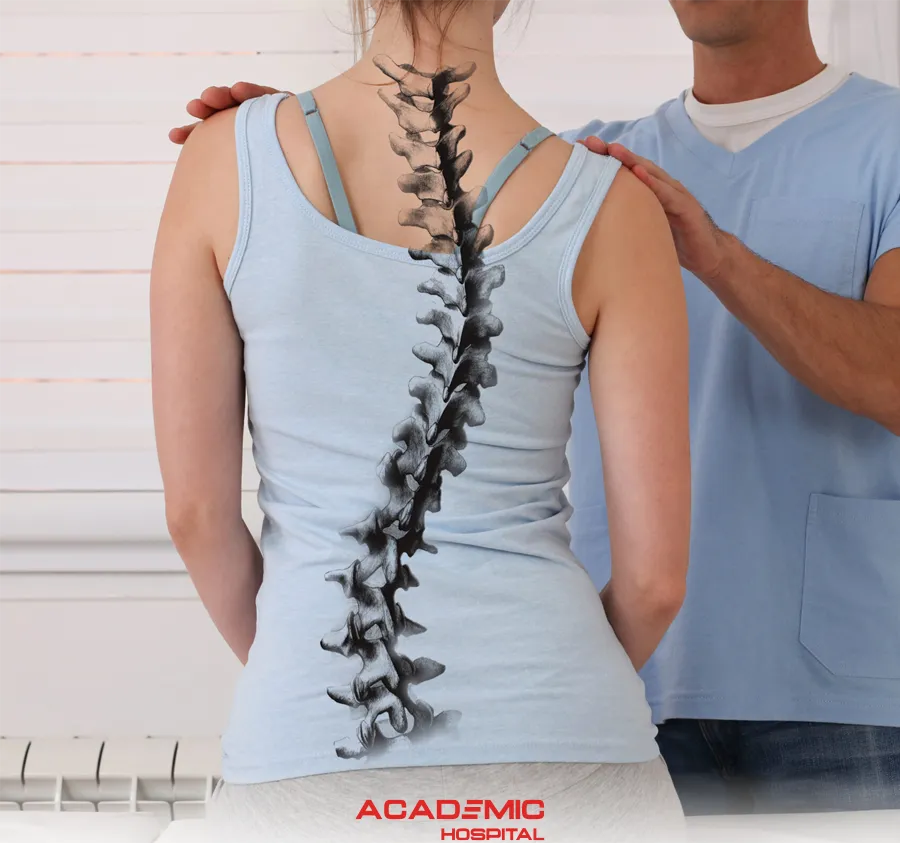
What Is Scoliosis? Symptoms, Diagnosis and Treatment in Children and Adults
Contents
- What Is Scoliosis?
- How Is Scoliosis Measured?
- What Are the Types of Scoliosis?
- Scoliosis in Children
- What Are the Signs in Children?
- How Is Scoliosis Diagnosed?
- How Is Scoliosis Treated in Children?
- Can Exercise Correct Scoliosis?
- When Is a Brace Used?
- When Is Surgery Considered in Children?
- What Is Adult Scoliosis?
- What Are the Symptoms in Adults?
- How Is Adult Scoliosis Treated?
- When Is Adult Scoliosis Surgery Considered?
- When Should You See a Doctor?
- Frequently Asked Questions
What Is Scoliosis?
Scoliosis is a three-dimensional spinal deformity in which a sideways curvature of the spine is accompanied by rotation of the vertebrae.
The spine may appear C- or S-shaped when viewed from the front or back. However, not every small lateral curve is classified as scoliosis. A standing spinal X-ray showing a Cobb angle greater than 10 degrees is the commonly used radiographic definition.
Scoliosis can occur at any age, from infancy to adulthood. The most common form is adolescent idiopathic scoliosis, which develops during the years of rapid growth.
How Is Scoliosis Measured?
The degree of scoliosis is usually measured on a standing spinal X-ray using the Cobb angle.
The upper and lower end vertebrae of the curve are identified and the angle between their endplates is calculated.
- Curves below 10 degrees are not usually classified as scoliosis.
- A Cobb angle greater than 10 degrees meets the radiographic definition of scoliosis.
- The Cobb angle alone does not determine whether treatment is required.
Age, skeletal maturity, curve pattern and progression on previous X-rays are also important.
What Are the Types of Scoliosis?
Idiopathic Scoliosis
Idiopathic scoliosis has no clearly identifiable cause and is the most common type in children and adolescents.
Congenital Scoliosis
Congenital scoliosis results from abnormalities in vertebral formation or segmentation during development before birth.
Neuromuscular Scoliosis
Neuromuscular scoliosis may occur with cerebral palsy, muscular disorders, spinal muscular atrophy and other neuromuscular conditions.
Syndromic Scoliosis
Scoliosis can occur as part of certain genetic and connective-tissue syndromes.
Adult Degenerative Scoliosis
Adult degenerative scoliosis develops later in life as discs and facet joints undergo degenerative changes.
Scoliosis in Children
Idiopathic scoliosis is the most common form seen during childhood and adolescence.
Adolescent idiopathic scoliosis generally develops from around the age of 10 until skeletal maturity in otherwise healthy children.
Many curves remain mild, but some can progress during periods of rapid growth.
Factors influencing the risk of progression include:
- The Cobb angle at diagnosis
- Remaining skeletal growth
- Curve location and pattern
- Evidence of progression on previous follow-up
What Are the Signs of Scoliosis in Children?
Scoliosis in children is often noticed because of asymmetry rather than pain.
Signs can include:
- One shoulder appearing higher than the other
- One shoulder blade appearing more prominent
- Uneven waist creases
- Uneven hips
- The trunk appearing shifted to one side
- One side of the ribs or lower back becoming more prominent when bending forwards
- Clothing hanging unevenly
Adolescent idiopathic scoliosis often does not cause significant pain. Persistent severe pain or neurological symptoms may require investigation for other causes.
How Is Scoliosis Diagnosed?
Assessment begins with physical examination.
The clinician may assess:
- Shoulder and shoulder-blade height
- Waist and hip symmetry
- Overall trunk balance
- Leg length
- Muscle strength, sensation and reflexes
Adam's Forward Bend Test
When the child bends forwards, prominence caused by vertebral and rib rotation may become easier to see.
Standing Spinal X-rays
Standing full-spine X-rays can confirm the diagnosis and allow the Cobb angle to be measured.
Skeletal maturity can also be assessed to estimate remaining growth and the risk of curve progression.
Does Every Child Need an MRI?
No. Routine MRI is not necessary for every child with typical adolescent idiopathic scoliosis.
MRI may be considered with very early onset, neurological findings, significant pain, unusual curve patterns or concern about an underlying spinal-cord disorder.
How Is Scoliosis Treated in Children?
Treatment is individualised according to the curve, age and risk of progression.
Options can include:
- Observation and monitoring
- Scoliosis-specific exercise or physiotherapy
- Bracing in appropriate patients
- Surgery for selected severe or progressive curves
Observation
Mild curves with a low risk of progression may only require active monitoring.
There is no universal follow-up interval for every child. The timing of follow-up depends on the Cobb angle, growth velocity, skeletal maturity and whether the curve is changing.
Can Exercise Correct Scoliosis?
Physical activity is important for general health, strength and function.
Scoliosis-specific exercise may help improve:
- Postural awareness
- Trunk control
- Muscle endurance
- Function and quality of life
Exercise does not automatically replace bracing or surgery when a structural curve has a significant risk of progression.
Swimming, Pilates and other forms of exercise can be healthy activities, but no single sport can be said to reliably straighten scoliosis or guarantee that it will not progress.
When Is a Brace Used for Scoliosis?
The main purpose of bracing is to reduce the risk that a curve will progress while the child or adolescent is still growing.
In adolescent idiopathic scoliosis, bracing is often considered in selected patients who:
- Are still growing
- Have a meaningful risk of progression
- Have curves approximately in the 25–45/50 degree range
These numbers are not an automatic prescription; skeletal maturity, progression and curve characteristics also matter.
When Is Surgery Considered in Children?
Most children with scoliosis do not require surgery.
Surgery may be considered when a curve is severe or has a high risk of further progression.
Decisions take into account:
- Cobb angle
- Documented progression
- Remaining growth
- Curve pattern and spinal balance
- Trunk deformity
- Previous treatment
For adolescents approaching skeletal maturity, spinal fusion using screws and rods is one of the most commonly used surgical approaches.
In early-onset scoliosis, treatment may instead use techniques designed to control the curve while preserving as much spinal and chest growth as possible.
What Is Adult Scoliosis?
Adult scoliosis commonly falls into two groups.
Adult Idiopathic Scoliosis
A curve that began in childhood or adolescence and remains present in adulthood.
De Novo Degenerative Scoliosis
A new spinal curve that develops in adulthood as discs and facet joints undergo age-related degeneration.
Adult spinal deformity may also include loss of normal lumbar lordosis, forward or sideways imbalance and spinal stenosis.
What Are the Symptoms of Adult Scoliosis?
Not every adult with scoliosis has symptoms.
When symptomatic, scoliosis may be associated with:
- Back or lower-back pain
- Pain radiating into the buttock or leg
- Numbness or tingling
- Leg weakness
- Reduced standing or walking tolerance
- Forward or sideways trunk imbalance
- Shoulder or hip asymmetry
- Reduced ability to perform daily activities
How Is Adult Scoliosis Treated?
Adult treatment is generally guided more by pain, neurological symptoms, spinal balance and functional limitation than by the X-ray angle alone.
Non-operative treatment may include:
- Individualised exercise and physiotherapy
- Core-strengthening programmes
- Activity modification
- Appropriate pain management
- Selected spinal injections
- Assessment and treatment of osteoporosis when appropriate
Spinal injections do not correct the scoliosis itself. In selected patients, they may help manage pain related to nerve irritation or associated spinal stenosis.
When Is Adult Scoliosis Surgery Considered?
Surgery is generally reserved for selected patients with significant symptoms who have not gained adequate benefit from reasonable non-operative treatment.
Reasons for surgical assessment may include:
- Disabling back or leg pain
- Progressive neurological deficit
- Significant nerve compression
- Severe spinal imbalance
- Progressive deformity
- Substantial reduction in quality of life and function
Surgery may involve neural decompression, restoration of spinal balance and fusion or stabilisation of selected spinal levels.
Adult scoliosis surgery can be a major spinal procedure. Age, bone quality, cardiovascular and respiratory health, diabetes, smoking, nutrition and the extent of the deformity should be included in the individual benefit-risk assessment.
When Should You See a Doctor?
A spinal assessment may be appropriate when a child or adolescent has:
- Uneven shoulder height
- A prominent shoulder blade
- Uneven waist or hips
- A rib prominence when bending forwards
- Known scoliosis that appears to be progressing
Adults may benefit from assessment when deformity progresses or when back pain, leg symptoms or walking difficulties significantly interfere with daily life.
New or progressive leg weakness, significant deterioration in walking or new bladder or bowel dysfunction requires prompt medical assessment.
Have Your Scoliosis and Spinal Alignment Assessed
Spinal curvature in children and adults can be assessed together with Cobb angle, remaining growth, spinal balance, neurological findings and its impact on daily function.
Frequently Asked Questions
References
- Academic Hospital. Skolyoz Nedir? Çocuklarda ve Erişkinlerde Skolyoz
- Scoliosis Research Society. Diagnosing Scoliosis
- Scoliosis Research Society. Adolescent Idiopathic Scoliosis
- Scoliosis Research Society. Bracing
- American Academy of Orthopaedic Surgeons. Nonsurgical Treatment Options for Scoliosis
- American Academy of Orthopaedic Surgeons. Surgical Treatment for Scoliosis
- NHS. Scoliosis – Treatment in Children
- NHS. Scoliosis – Treatment in Adults
- Scoliosis Research Society. Adult Scoliosis