
 WhatsApp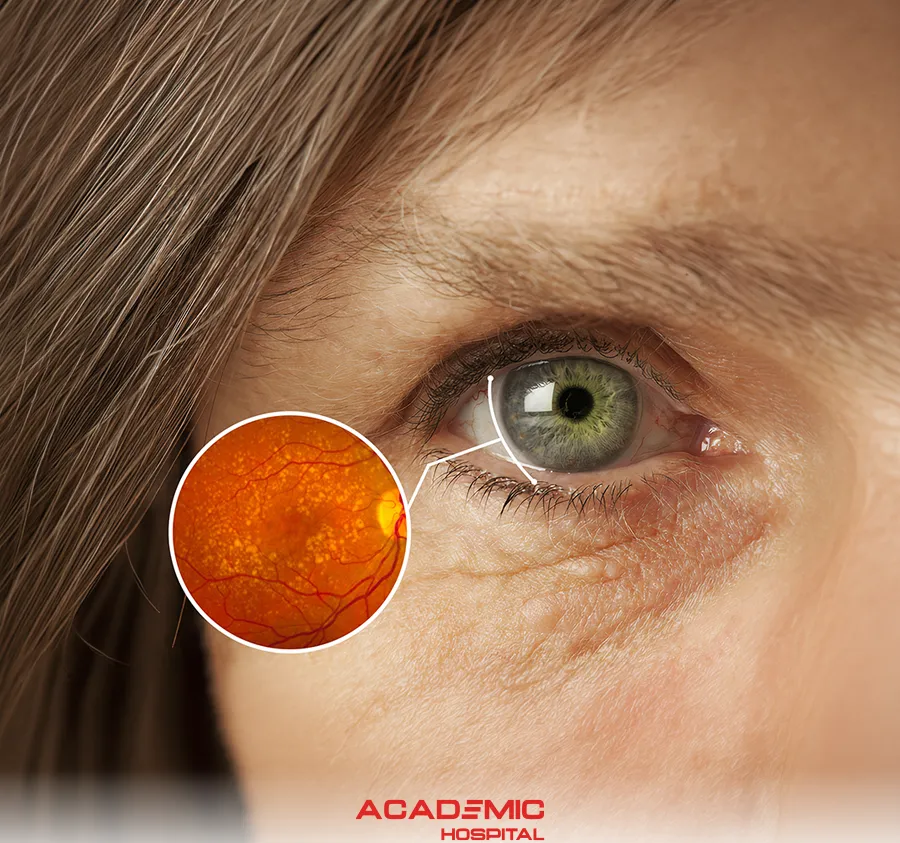
What Is Age-Related Macular Degeneration? Symptoms and Treatment
Contents
- What Is Age-Related Macular Degeneration?
- What Are Dry and Wet AMD?
- What Are the Symptoms?
- What Are the Risk Factors?
- How Is AMD Diagnosed?
- What Is an Amsler Grid?
- How Is AMD Treated?
- How Is Wet AMD Treated?
- How Is Dry AMD Treated?
- What Is AREDS2?
- Who May Benefit From AREDS2?
- How Can AMD Progression Risk Be Reduced?
- Which Visual Changes Require Prompt Assessment?
- Frequently Asked Questions
What Is Age-Related Macular Degeneration?
Age-related macular degeneration (AMD) is a progressive eye disease affecting the macula, the central part of the retina responsible for detailed central vision.
The macula plays an important role in reading, recognising faces, driving, seeing fine detail and distinguishing colours.
As AMD progresses, central vision may become blurred, distorted or lost, while peripheral vision can remain relatively preserved.
What Are Dry and Wet AMD?
Dry AMD
Dry AMD is the more common form and usually progresses more slowly. Drusen and degenerative changes involving retinal cells can develop over time.
An advanced form of dry AMD is known as geographic atrophy, in which areas of retinal and supporting tissue are progressively lost.
Wet AMD
Wet, or neovascular, AMD occurs when abnormal new blood vessels grow beneath the macula and leak fluid or blood.
Because wet AMD can cause relatively rapid central vision loss, early diagnosis and treatment are important.
What Are the Symptoms of AMD?
- Blurred central vision
- Straight lines appearing bent or wavy
- Missing areas of words while reading
- Difficulty recognising faces
- A dark, blurred or empty area in central vision
- Reduced colour intensity
- Difficulty seeing in low light
What Are the Risk Factors for AMD?
Risk increases with age. Smoking, family history and genetic susceptibility, cardiovascular risk factors and excess body weight can also contribute to AMD risk.
Stopping smoking is particularly important for reducing modifiable AMD risk.
How Is AMD Diagnosed?
Assessment may include visual-acuity testing, dilated retinal examination, optical coherence tomography (OCT), retinal photography and, when needed, fluorescein angiography or OCT angiography.
OCT provides detailed cross-sectional images of the macula and is particularly useful for detecting retinal fluid, structural change, atrophy and signs of neovascular AMD.
What Is an Amsler Grid?
An Amsler Grid is a simple grid that can help patients notice changes in central vision.
Lines that suddenly appear wavy, broken or missing may indicate a new macular change.
The grid does not replace a professional retinal examination.
How Is Age-Related Macular Degeneration Treated?
Treatment depends on the stage of AMD and whether the disease is dry or wet.
Management may include observation and risk-factor modification, AREDS2 supplementation in appropriate patients, intravitreal anti-VEGF treatment for wet AMD and selected treatments for geographic atrophy.
How Is Wet AMD Treated?
The main treatment for wet AMD is intravitreal anti-VEGF therapy.
Anti-VEGF medicines reduce abnormal blood-vessel activity and leakage in the macula. They can slow vision loss and some patients may experience improvement in vision.
Treatment usually requires repeated injections. The schedule depends on the medicine used, OCT findings and individual response.
Photodynamic therapy is used less often but may be considered in selected situations.
How Is Dry AMD Treated?
Early dry AMD is usually managed with regular retinal examinations and modification of risk factors such as smoking.
AREDS2 supplementation may be appropriate for patients with intermediate AMD.
Treatment options for advanced dry AMD with geographic atrophy have also changed. Complement-targeting intravitreal medicines have been approved in the United States to slow geographic-atrophy lesion growth in selected patients.
These treatments do not restore retinal cells that have already been lost. Availability and regulatory approval vary between countries, and treatment suitability must be assessed individually by a retinal specialist.
What Is the AREDS2 Supplement?
AREDS2 is a specific vitamin and mineral formulation studied by the National Eye Institute in patients with age-related macular degeneration.
The standard formulation contains:
- Vitamin C – 500 mg
- Vitamin E – 400 IU
- Zinc – 80 mg
- Copper – 2 mg
- Lutein – 10 mg
- Zeaxanthin – 2 mg
The AREDS2 formulation does not contain beta-carotene.
Who May Benefit From AREDS2?
The clearest benefit has been demonstrated in people with intermediate AMD and selected people with late AMD in one eye who remain at risk of progression in the other eye.
AREDS2 has not been shown to prevent AMD in people who do not have the disease, and it does not prevent early AMD from progressing to intermediate AMD.
Are Omega-3 Supplements Part of AREDS2?
No. The AREDS2 trial did not show an additional reduction in AMD progression from adding omega-3 fatty acids to the AREDS formulation.
Omega-3 is therefore not part of the standard AREDS2 formula.
Does AREDS2 Contain Vitamin A?
No. Standard AREDS2 does not contain vitamin A.
How Can the Risk of AMD Progression Be Reduced?
- Do not smoke.
- Maintain a balanced diet including vegetables and leafy greens.
- Remain physically active.
- Manage blood pressure, blood glucose and cardiovascular risk factors.
- Attend scheduled retinal examinations.
- Use an Amsler Grid if recommended by your ophthalmologist.
Which Visual Changes Require Prompt Assessment?
- Straight lines suddenly appearing bent or wavy
- Sudden reduction or blurring of central vision
- A new dark or empty area in central vision
- New distortion in one eye compared with the other
- A rapid new difficulty reading or recognising faces
The Type and Stage of AMD Determine Treatment
Dry and wet AMD require different approaches. Retinal examination and OCT can help determine whether monitoring, AREDS2 supplementation, intravitreal treatment or another approach is appropriate.
Frequently Asked Questions
References
- Academic Hospital. Age-Related Macular Degeneration
- National Eye Institute. Age-Related Macular Degeneration
- National Eye Institute. AREDS 2 Supplements for AMD
- National Eye Institute. AREDS/AREDS2 Clinical Trials
- National Eye Institute. Treatments for Wet AMD
- U.S. Food and Drug Administration. IZERVAY – Geographic Atrophy Secondary to AMD