
 WhatsApp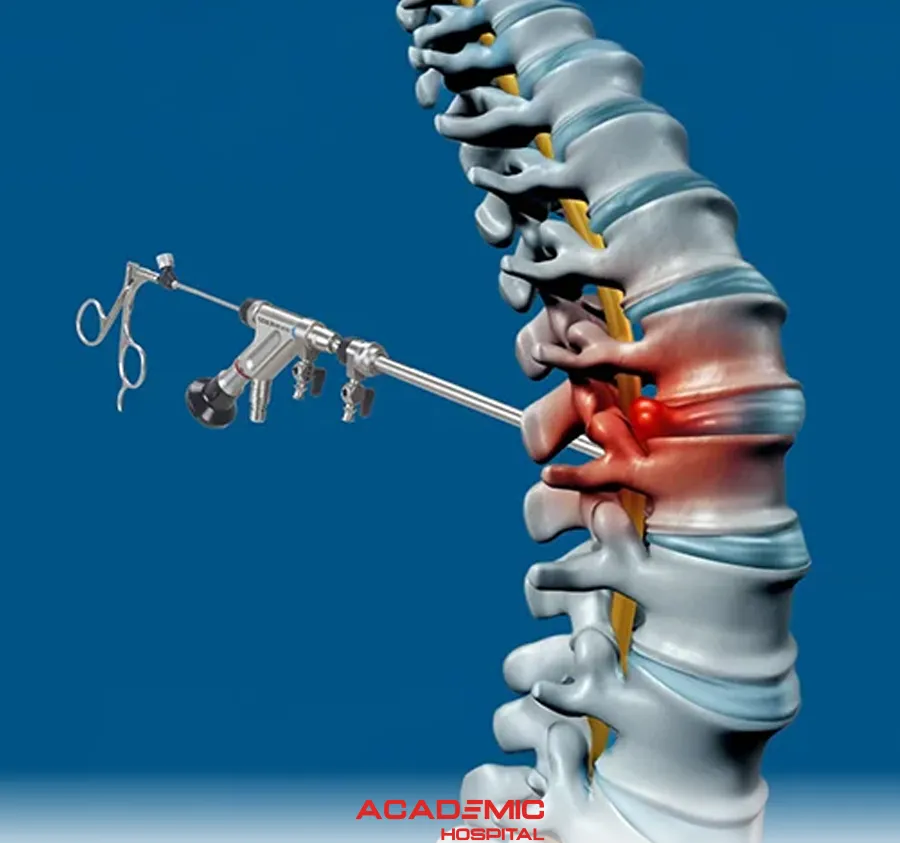
What Is a Lumbar Disc Herniation? Symptoms, Treatment and Endoscopic Discectomy
Contents
- What Is a Lumbar Disc Herniation?
- What Causes a Herniated Disc?
- What Are the Symptoms?
- Which Symptoms Are an Emergency?
- How Is It Diagnosed?
- How Is It Treated?
- When Is Surgery Needed?
- What Is Microdiscectomy?
- What Is Endoscopic Discectomy?
- Potential Advantages
- Who Is Suitable?
- Recovery
- Frequently Asked Questions
What Is a Lumbar Disc Herniation?
Lumbar disc herniation occurs when material from an intervertebral disc extends beyond its normal boundary and may compress or irritate a nearby nerve root.
A disc abnormality on MRI does not necessarily cause symptoms. Imaging findings should therefore be interpreted together with the patient's pain pattern and neurological examination.
What Causes a Lumbar Disc Herniation?
Disc herniation often develops through age-related degeneration rather than a single traumatic event.
- Age-related disc degeneration
- Repeated lifting or physical strain
- Poor lifting technique
- Excess body weight
- Smoking
- Physical inactivity
- Certain occupational loads
- Genetic susceptibility
What Are the Symptoms?
- Low-back pain
- Pain radiating into the buttock or leg
- Numbness or tingling
- Burning or electric-shock-like pain
- Weakness in specific muscle groups
- Reduced reflexes
Which Symptoms Require Urgent Assessment?
- New or progressive significant leg weakness
- Marked weakness of the foot or ankle
- Urinary retention or new loss of bladder control
- New bowel-control problems
- Numbness around the perineum or genitals
- Significant neurological symptoms affecting both legs
These symptoms may indicate cauda equina syndrome and require urgent medical evaluation.
How Is It Diagnosed?
Assessment begins with medical history and neurological examination. Muscle strength, sensation, reflexes and walking function may be evaluated.
MRI is commonly used to identify disc herniation and nerve-root compression, particularly when neurological findings are present or surgery is being considered.
How Is a Lumbar Disc Herniation Treated?
Many episodes of sciatica related to disc herniation improve without surgery.
Treatment may include activity modification, appropriate medication, physiotherapy, exercise and selected epidural injections.
When Is Surgery Needed?
Surgical treatment may be considered for:
- Persistent disabling leg pain despite appropriate non-operative treatment
- Progressive motor weakness
- Significant neurological impairment
- Cauda equina syndrome
What Is Microdiscectomy?
Microdiscectomy is a well-established procedure in which the herniated disc fragment is removed through a relatively small surgical exposure using magnification or an operating microscope.
What Is Full-Endoscopic Lumbar Discectomy?
Endoscopic discectomy is a minimally invasive technique that uses a small endoscope containing a camera and working channel to remove disc material compressing a nerve root.
Depending on the location and anatomy, transforaminal or interlaminar approaches may be used.
What Are the Potential Advantages?
- Small surgical incision
- Limited disruption of muscles and soft tissue
- Potentially less postoperative pain
- Early mobilisation
- Potential for short hospital stay or same-day discharge
- Potentially earlier return to activities
Is Every Herniated Disc Suitable for Endoscopic Surgery?
No. Suitability depends on spinal level, location and migration of the disc fragment, bony anatomy, associated stenosis, instability and previous surgery.
What Is Recovery Like?
Many patients can mobilise early after minimally invasive surgery.
Same-day discharge may be possible for selected patients, while others may require overnight or longer observation.
Radiating leg pain may improve quickly, while long-standing numbness or weakness may recover more slowly.
Assessment for Lumbar Disc Herniation and Endoscopic Surgery
MRI findings, neurological examination and surgical and non-surgical options can be evaluated together.
Frequently Asked Questions
References
- Academic Hospital. Lumbar Disc Herniation and Endoscopic Discectomy
- North American Spine Society. Diagnosis and Treatment of Lumbar Disc Herniation with Radiculopathy