

 WhatsApp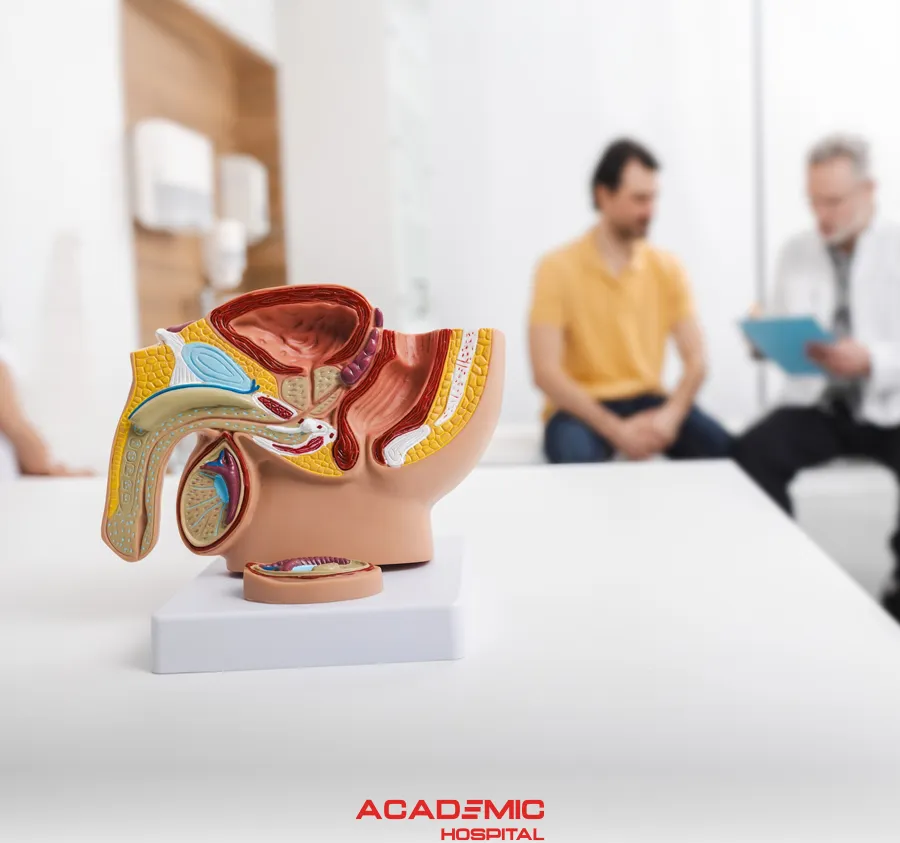
What Is the Prostate? Benign Prostate Enlargement, Prostate Cancer and Prostatitis
Contents
- What Is the Prostate?
- Common Prostate Conditions
- What Is Benign Prostatic Hyperplasia?
- Symptoms of BPH
- How Is BPH Assessed?
- How Is BPH Treated?
- When Is Surgery Needed?
- What Is Prostate Cancer?
- Symptoms of Prostate Cancer
- Early Detection of Prostate Cancer
- What Is the PSA Test?
- When Is Prostate MRI Used?
- What Is a Prostate Biopsy?
- How Is Prostate Cancer Treated?
- Sexual Activity, Ejaculation and Prostate Cancer
- What Is Prostatitis?
- Symptoms of Prostatitis
- How Is Prostatitis Treated?
- When Is Urgent Assessment Needed?
- Frequently Asked Questions
What Is the Prostate?
The prostate is a gland of the male reproductive system located below the bladder and in front of the rectum. It surrounds the first part of the urethra.
One of its main functions is to contribute fluid to semen, supporting the transport and function of sperm.
The prostate undergoes structural changes with age, but prostate enlargement does not automatically mean prostate cancer.
Common Prostate Conditions
- Benign prostatic hyperplasia (BPH)
- Prostate cancer
- Prostatitis and chronic pelvic pain syndromes
What Is Benign Prostatic Hyperplasia?
Benign prostatic hyperplasia (BPH) is non-cancerous enlargement of prostate tissue and becomes more common with age.
In some men, enlargement can contribute to bladder-outlet obstruction and lower urinary tract symptoms.
Prostate size and symptom severity do not always correlate. A relatively small prostate may cause significant symptoms, while a larger prostate may cause relatively few.
Symptoms of BPH
Voiding symptoms can include:
- Difficulty starting urination
- Weak urinary stream
- Intermittent flow
- Straining
- Feeling of incomplete emptying
- Post-void dribbling
Storage symptoms can include:
- Urinary frequency
- Urgency
- Nocturia
- Urgency urinary incontinence in some men
Burning or painful urination is not specific to BPH and may require evaluation for infection, prostatitis or another cause.
How Is BPH Assessed?
Depending on the patient's circumstances, evaluation may include:
- Detailed symptom history
- Medication review
- Physical examination
- Urinalysis
- PSA when clinically appropriate
- Urinary flow measurement
- Post-void residual urine measurement
- Ultrasound and prostate-volume assessment
- Kidney-function testing when indicated
How Is BPH Treated?
Not every man with BPH needs medication or surgery.
Mild symptoms that cause little bother may be managed with observation and lifestyle measures.
Medication options can include:
- Alpha-1 blockers
- 5-alpha-reductase inhibitors
- Tadalafil
- Antimuscarinic or beta-3 agonist therapy for selected storage symptoms
- Combination therapy in appropriately selected patients
Alpha blockers can improve symptoms relatively quickly, whereas 5-alpha-reductase inhibitors are particularly useful in men with larger prostates and a higher risk of disease progression.
When Is Surgery Needed for BPH?
Surgical or interventional treatment may be appropriate for:
- Recurrent or refractory urinary retention
- Recurrent urinary tract infections related to obstruction
- Bladder stones
- Recurrent significant haematuria due to BPH
- Upper urinary tract dilatation or kidney dysfunction caused by obstruction
- Persistent bothersome symptoms despite conservative or medical treatment
Treatment options include TURP, bipolar resection or enucleation, laser techniques such as HoLEP and other selected minimally invasive approaches.
What Is Prostate Cancer?
Prostate cancer develops when malignant cells grow within the prostate gland.
Its biological behaviour varies considerably. Some prostate cancers remain slow-growing for many years, while others behave more aggressively.
Risk stratification therefore incorporates PSA, tumour grade, stage, MRI and biopsy findings and the patient's overall health.
Symptoms of Prostate Cancer
Early prostate cancer often causes no symptoms.
More advanced disease can be associated with urinary difficulty, blood in urine or semen, pelvic discomfort, bone pain or systemic symptoms.
These symptoms are not specific to prostate cancer and require appropriate evaluation.
Early Detection of Prostate Cancer
There is no single screening schedule that is appropriate for every man.
Modern prostate-cancer early detection is risk-adapted and should consider age, life expectancy, general health, family history, genetic risk and previous PSA values.
What Is the PSA Test?
Prostate-specific antigen (PSA) is a protein produced by prostate cells and measured in the blood.
PSA can be elevated in prostate cancer, but benign prostate enlargement, prostatitis and other urological conditions can also increase PSA.
One elevated PSA result does not automatically mean cancer or an immediate biopsy. Repeat testing, prostate volume, PSA density, family history, MRI and other risk factors may be considered.
When Is Prostate MRI Used?
Multiparametric prostate MRI plays an important role in the modern diagnostic pathway for clinically significant prostate cancer.
It can help identify suspicious lesions, reduce unnecessary biopsies in selected men and guide targeted biopsy when required.
A negative MRI does not completely exclude clinically significant prostate cancer, so the total clinical risk remains important.
What Is a Prostate Biopsy?
Definitive diagnosis of prostate cancer generally requires microscopic examination of prostate tissue obtained by biopsy.
If MRI shows a suspicious lesion, targeted biopsies may be performed. Systematic or regional samples may also be obtained according to the individual's risk.
Biopsy may be performed through a transperineal or transrectal approach depending on clinical and institutional factors.
How Is Prostate Cancer Treated?
Treatment is individualised according to PSA, Grade Group/Gleason characteristics, stage, imaging findings, age, life expectancy, comorbidities and the potential urinary and sexual effects of treatment.
Active Surveillance
Active surveillance is a standard option for many patients with low-risk prostate cancer and selected patients with favourable intermediate-risk disease.
Patients are monitored with PSA, clinical assessment, MRI and repeat biopsy where appropriate, with curative treatment introduced if evidence of progression appears.
Radical Prostatectomy
Surgical removal of the prostate and seminal vesicles may be considered in appropriate patients with localised or selected locally advanced disease.
Radiotherapy
External-beam radiation or brachytherapy can be used alone or in combination with androgen-deprivation therapy depending on disease risk.
Systemic Therapy
Advanced or metastatic prostate cancer may be treated with androgen-deprivation therapy, newer hormonal agents, chemotherapy, radiopharmaceuticals and selected targeted treatments according to tumour biology.
Sexual Activity, Ejaculation and Prostate Cancer
There is no reliable evidence that frequent sexual intercourse or ejaculation causes prostate cancer.
Some observational studies have reported an association between more frequent ejaculation and lower prostate-cancer risk, but observational associations do not establish causation.
Frequent ejaculation should therefore not be presented as a proven method of preventing prostate cancer.
What Is Prostatitis?
Prostatitis is a general term encompassing several disorders involving infection, inflammation or chronic pelvic pain.
Major categories include:
- Acute bacterial prostatitis
- Chronic bacterial prostatitis
- Chronic prostatitis / chronic pelvic pain syndrome
- Asymptomatic inflammatory prostatitis
Prostatitis is different from both BPH and prostate cancer and has not been shown to increase the risk of prostate cancer.
Symptoms of Prostatitis
Acute bacterial prostatitis can cause:
- Fever and chills
- Burning urination
- Frequency and urgency
- Weak urinary stream
- Urinary retention
- Pain in the perineum, groin, genital area or lower back
Chronic prostatitis/chronic pelvic pain syndrome may involve persistent pelvic pain together with urinary or sexual symptoms.
How Is Prostatitis Treated?
Treatment depends on the subtype.
Acute bacterial prostatitis requires appropriate antibiotic therapy, and systemically unwell patients may require hospital admission and intravenous treatment.
Chronic bacterial prostatitis may require prolonged, microbiology-guided antimicrobial treatment.
Chronic pelvic pain syndrome does not necessarily involve bacterial infection. Management can include alpha blockers, pain treatment, pelvic-floor physiotherapy and other multimodal approaches depending on symptoms.
When Is Urgent Assessment Needed?
- Complete inability to urinate
- Fever and chills with urinary symptoms
- Marked systemic illness or confusion
- Heavy haematuria or blood clots
- Severe pelvic or back pain with fever
- New severe bone pain, leg weakness or sudden bladder/bowel dysfunction in a patient with known prostate cancer
Have Prostate and Urinary Symptoms Assessed
If you have a weak urinary stream, frequent night-time urination, an elevated PSA, prostate-cancer risk or symptoms of prostatitis, a urological assessment can be planned.
Frequently Asked Questions
References
- Academic Hospital. Prostate Enlargement, Prostate Cancer and Prostatitis
- European Association of Urology. EAU Guidelines on Non-neurogenic Male LUTS – Disease Management
- European Association of Urology. EAU Guidelines on Prostate Cancer – 2026
- European Association of Urology. EAU Guidelines on Urological Infections – Bacterial Prostatitis
- National Cancer Institute. Prostate-Specific Antigen (PSA) Test
- American Urological Association / Society of Urologic Oncology. Early Detection of Prostate Cancer: Considerations for a Prostate Biopsy