
 WhatsApp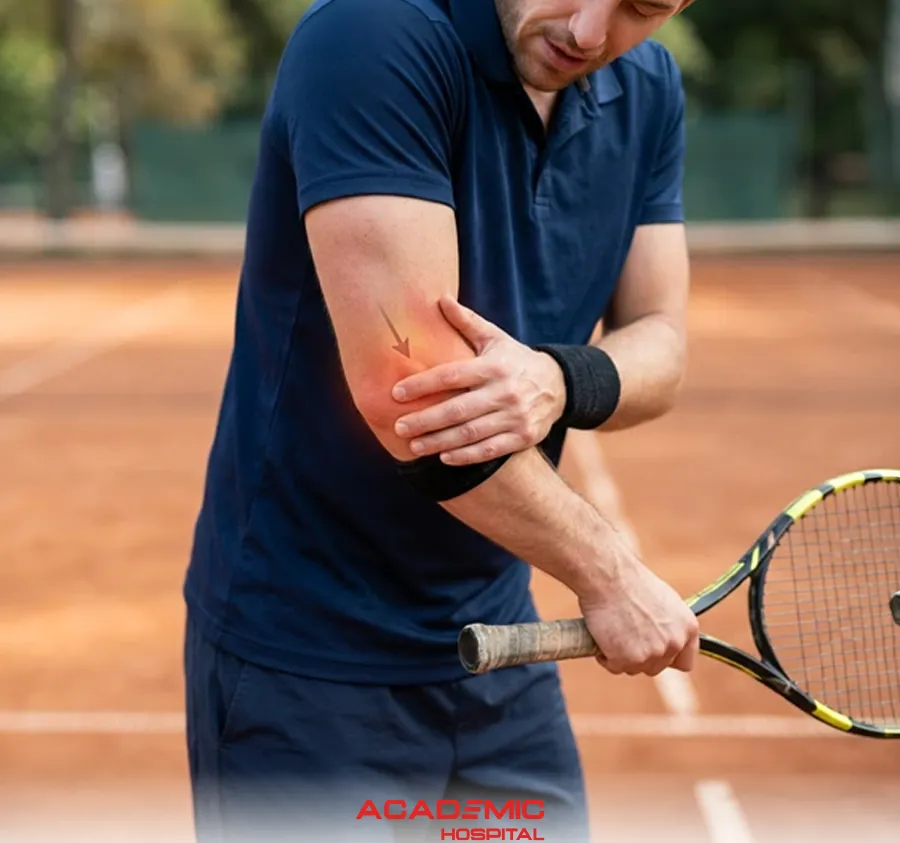
What Are Tennis Elbow and Golfer's Elbow? Symptoms and Treatment
Contents
- What Is Tennis Elbow?
- What Are the Symptoms of Tennis Elbow?
- What Is Golfer's Elbow?
- What Are the Symptoms of Golfer's Elbow?
- What Causes These Conditions?
- What Is the Difference?
- How Are They Diagnosed?
- How Are They Treated?
- Exercise and Physical Therapy
- Are Corticosteroid or PRP Injections Used?
- When Is Surgery Considered?
- How Can Recurrence Be Reduced?
- When Should You Seek Medical Assessment?
- Frequently Asked Questions
What Is Tennis Elbow?
Tennis elbow, also known as lateral epicondylalgia or lateral epicondylitis, is an overuse-related tendinopathy affecting tendons that attach to the outer aspect of the elbow and help extend the wrist.
Despite its name, tennis elbow is not limited to tennis players. Repetitive gripping, lifting, tool use, racquet sports and other activities involving repeated wrist extension can contribute.
The condition is generally related to repetitive tendon overload and degenerative tendon change rather than a complete muscle or tendon tear from the bone.
What Are the Symptoms of Tennis Elbow?
The typical symptom is pain and tenderness over the bony prominence on the outside of the elbow.
Pain may worsen when gripping, shaking hands, turning a door handle, lifting an object, extending the wrist or using a racquet or hand tool.
Pain can radiate into the forearm and grip strength may feel reduced.
What Is Golfer's Elbow?
Golfer's elbow, also known as medial epicondylitis or medial epicondylalgia, is an overuse-related tendinopathy affecting the flexor-pronator tendon group on the inner aspect of the elbow.
These muscles and tendons are involved in wrist flexion, gripping and forearm pronation.
The condition can occur in golfers but also in people involved in throwing sports, weight training, racquet sports or occupations involving repetitive gripping and wrist activity.
What Are the Symptoms of Golfer's Elbow?
Pain and tenderness are usually located on the inside of the elbow.
Symptoms can increase with wrist flexion, forearm pronation, gripping, lifting and throwing activities.
Pain may extend down the inner aspect of the forearm.
What Causes Tennis Elbow and Golfer's Elbow?
Both conditions are usually caused by repetitive loading that exceeds the tendon's current capacity.
Contributing factors may include sudden increases in training or workload, repetitive wrist and forearm movements, poor sports technique, unsuitable equipment and occupations requiring frequent forceful gripping.
What Is the Difference Between Tennis Elbow and Golfer's Elbow?
- Tennis elbow: Pain is located on the outer elbow and primarily involves the wrist extensor tendon group.
- Golfer's elbow: Pain is located on the inner elbow and primarily involves the flexor-pronator tendon group.
Because the ulnar nerve runs close to the inner elbow, some patients with medial elbow pain may also experience numbness or tingling into the ring and little fingers. Additional evaluation for ulnar-nerve compression may then be required.
How Are Tennis Elbow and Golfer's Elbow Diagnosed?
Diagnosis can usually be made from the history and physical examination.
The location of tenderness, grip strength and pain with resisted wrist movements are assessed.
X-ray, ultrasound or MRI is not routinely required in every patient but may be used when the diagnosis is uncertain, significant weakness or trauma is present, symptoms persist despite treatment or another elbow disorder is suspected.
How Are Tennis Elbow and Golfer's Elbow Treated?
Most patients can be treated without surgery.
Initial management can include:
- Temporary reduction of activities that provoke pain
- Modification of sports or work technique
- Ice for symptom relief
- Short-term analgesic or NSAID use when appropriate
- Physical therapy and progressive tendon-loading exercises
- A counterforce strap or wrist support in selected patients
Complete immobilisation is generally not the goal. Progressive loading within tolerable limits is an important part of rehabilitation.
What Is the Role of Exercise and Physical Therapy?
Rehabilitation aims to improve the tendon's capacity to tolerate load as well as reduce symptoms.
A programme may include forearm stretching, isometric strengthening, progressive concentric and eccentric loading, grip-strength exercises and strengthening of the shoulder and scapular muscles.
Exercise should be adapted to the patient's symptoms, occupation, sport and current physical capacity.
Are Corticosteroid or PRP Injections Used?
Corticosteroid Injections
Corticosteroid injections can provide short-term pain relief in some patients. However, particularly in chronic tennis elbow, they have not demonstrated superior long-term outcomes and may be associated with higher recurrence rates.
They are therefore not routinely required for every patient. Repeated injections can also carry risks including tendon weakening, subcutaneous atrophy and skin colour changes.
PRP Injections
Platelet-rich plasma (PRP) is prepared from the patient's own blood and injected into or around the affected tendon.
Some studies suggest possible benefit in chronic lateral epicondylalgia, but the evidence is not completely consistent and the patients most likely to benefit remain uncertain.
PRP should therefore not be considered a replacement for appropriate load management and rehabilitation.
When Is Surgery Considered?
Surgery is rarely required.
It may be considered in selected patients with persistent, function-limiting symptoms despite several months of appropriate non-surgical management.
For tennis elbow, surgery is generally considered only after approximately 6–12 months of unsuccessful conservative treatment.
The operation does not simply involve “sewing a torn muscle back to the bone”. Depending on the procedure, abnormal tendon tissue can be removed and the tendon attachment may be repaired or reconstructed.
How Can Recurrence Be Reduced?
- Increase work or training load gradually.
- Use appropriate sporting and occupational technique.
- Take breaks during repetitive activities.
- Maintain forearm and grip strength.
- Use appropriately sized and weighted equipment.
- Avoid repeatedly working through increasing tendon pain.
When Should You Seek Medical Assessment?
- Elbow pain that does not improve over several weeks
- Pain that significantly interferes with daily activities or sleep
- Marked weakness
- Swelling or restricted elbow movement
- Severe pain following an injury
- Numbness or tingling into the ring or little finger
- Symptoms that continue to worsen despite treatment
Correct Diagnosis Is the First Step in Treating Elbow Pain
Tennis elbow and golfer's elbow can usually be managed without surgery. Treatment is individualised according to the affected tendon, workload and any associated nerve or joint problem.
Frequently Asked Questions
References
- Academic Hospital. Tennis Elbow and Golfer's Elbow
- American Orthopaedic Society for Sports Medicine. Tennis Elbow
- American Society for Surgery of the Hand. Overuse Injuries of the Elbow
- Mayo Clinic Orthopedics & Sports Medicine. Tennis Elbow – Treatment